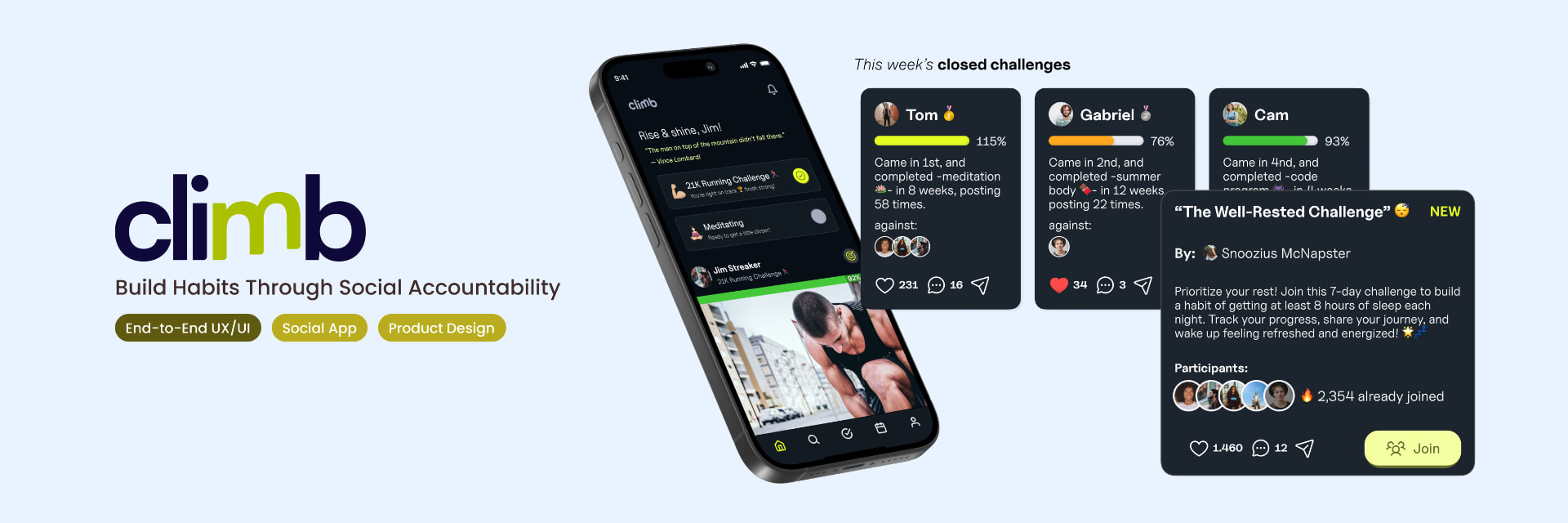
Most people struggle to build and sustain good habits — not for lack of intention, but for lack of motivation, consistency, and social support. Traditional habit-tracking apps focus on personal goals but miss the social engagement that actually reinforces commitment, so users drift and drop off. The opportunity was to use community and accountability to make habit formation engaging and sustainable — a collective journey rather than a solitary task.
The solution
Climb is a social app for building and keeping habits through group accountability and motivation. Users create or join a Climb, where each participant commits to a specific habit for a set period. Instead of paying upfront, each person defines a penalty they only pay if they miss their check-ins — and that money is redistributed among the participants who did follow through. It uses social responsibility and a small economic incentive to help people stay consistent, deliberately framed as accountability rather than gambling. Habits span exercise, reading, meditation and more, and a "life-saver" mechanic lets someone request an exception when they genuinely can't meet their commitment — illness or exceptional circumstances.
Timeline
Oct 2024 – Dec 2025
The team
Cala Largacha – UX/UI Designer (end-to-end)
Juan Mejía – Product Manager & Developer
Originally launched as Surgo, later rebranded to Climb – The Challenge
Project timeline
Concept & foundations
Benchmark, basic style guide, and low-fidelity wireframes for the core screens (intro, onboarding, habit creation)
High-fidelity & iteration
High-fi mockups of the main screens, additional flows (social feed, individual post, accountability detail), and internal-feedback rounds
Product & visual system
Refined navigation architecture, componentized recurring elements in Figma, and defined the visual identity (logo, palette, typography, base components)
Challenge experience
Challenge-completion and results experience (streak, consistency, ranking) and the Discovery page for finding new challenges
Usability testing
Tests with 12 participants running real Climbs, feeding insights back into the flows
Penalty model redesign
Shifted from upfront betting to conditional penalties — more transparent, fair, and accountability-centered
Current iteration
Refinement of Home, Climb Landing, Create a Climb, Profile, Onboarding, penalty settlement, and cancellation flows
Climb – The Challenge — key screens.
How might we use community and accountability to make habit formation engaging and sustainable?
Climb turns habit-building from a solitary task into a collective journey: group challenges, social proof, and a fair penalty model that only charges you if you don't follow through.
🏢 Business problem
Habit-tracking apps struggle with retention: users drift and drop off because personal-goal tools miss the social engagement that reinforces commitment. The opportunity was to differentiate through community and accountability mechanics.
👤 User problem
People want to build good habits but lack motivation, consistency, and social support. Tracking alone feels like a chore, so intention fades and the habit never sticks.
Habit apps miss the social support that keeps people consistentGroup challenges with accountability and conditional penalties
🎯 My role
I owned the end-to-end UX/UI of the platform, working on it in parallel with my other projects, alongside Juan Mejía, who led product management and development.
•Product and UX design, flow definition and experience architecture
•UX writing and microcopy across the whole product
•Screen and visual design, plus the design system
•Usability testing with real participants
•Initial market study and the rebrand from Surgo to Climb – The Challenge
•Core flows: onboarding, Home, Climb Landing, Create a Climb, Profile, chat and social interaction, check-ins, life-saver, cancellation, and penalty settlement
User research
Research & usability testing
I began with a benchmark of comparable habit and accountability apps to understand what already worked and where Climb could differentiate. Later I ran usability tests with 12 participants who were actively betting on real challenges — reading, exercise, running three times a week, skincare, and others. Their feedback helped me adjust how people interacted with the platform, and it surfaced a key insight: the act of continuously sending check-in photos gave participants a genuine sense of wanting to complete the challenge themselves — the social proof of others' progress became its own motivator. That reframed the check-in from a compliance step into an engagement driver.
Climb usability testing boardDrop image here
Journey map
Product definition & architecture
The heart of this project was designing mechanics, not just interfaces. I translated an abstract idea — accountability — into a concrete loop: habit → commitment → check-in → accountability → consequence → reward. From there I defined the app's structure and its main flows, iterating the architecture across versions toward clarity and scalability. Create a Climb is a good example: it started as one long single-screen form and became a guided, stepped flow — what climb are you creating, who's in, when are we climbing, how do we keep it up, and a final summary — far easier to complete.
Climb experience architecture and flowsDrop image here
Design + iterations
A visual system built for fairness
I built Climb's visual system — an acid-green (#B9D10A), lavender (#A799FF), and navy (#0F093A) palette, a logo designed and exported as configurable SVG variants, and a documented component library (inputs, buttons, cards, radio buttons, toggles, progress indicators, navigation, chat elements, and forms with their flow states). The biggest design shift came with the penalty-model redesign: moving from "I put money in to participate" to "I commit, and only pay if I don't follow through" changed the whole perception of the product, and I reworked the experience and flow architecture around it to keep the system feeling transparent and fair — especially important when real money is involved.
Climb visual identity and component libraryDrop image here
Outcomes and impact
Climb evolved from an early concept (Surgo) into a coherent, rebranded product with a full experience and visual system — a navigable prototype covering the complete habit loop, from creating a Climb through check-ins, penalties, and settlement, validated through usability testing with real users. Across more than a year, it grew from a single-screen idea into a whole social-accountability service with its own identity, mechanics, and design language, and was handed over to the product owner to take into development.
What I learned
I learned that designing a habit-building product isn't only about making progress visible — the real challenge is designing the rules and social dynamics that make people want to come back and stay accountable. Testing with real users proved it: watching others post their check-ins was what made participants want to complete their own challenge, turning a routine step into the product's strongest motivator. I learned to design product mechanics, not just screens — turning something abstract like accountability into concrete behaviors and flows — and to treat fairness and transparency as core UX concerns once real money enters the experience. Climb taught me that good habit-building experiences aren't about forcing people to be consistent; they're about creating the right combination of commitment, community, and accountability to make consistency feel achievable.
Want the full walkthrough?
Happy to walk you through the research, the iterations and the final screens in detail.